Companion Guide
The Third Phase – Backstage A Companion Guide
Part One — Discussion Guide
Open-ended questions, organized by the novel’s own parts, and written to be read alongside the book rather than after it.
Part Two — Going Deeper
Questions organized by theme rather than by chapter, and written for readers who have finished the book.
Part Three — Outside the Book
Questions that step outside the novel to compare it with the two works it echoes most: Plato’s Republic and St. Augustine’s Confessions.
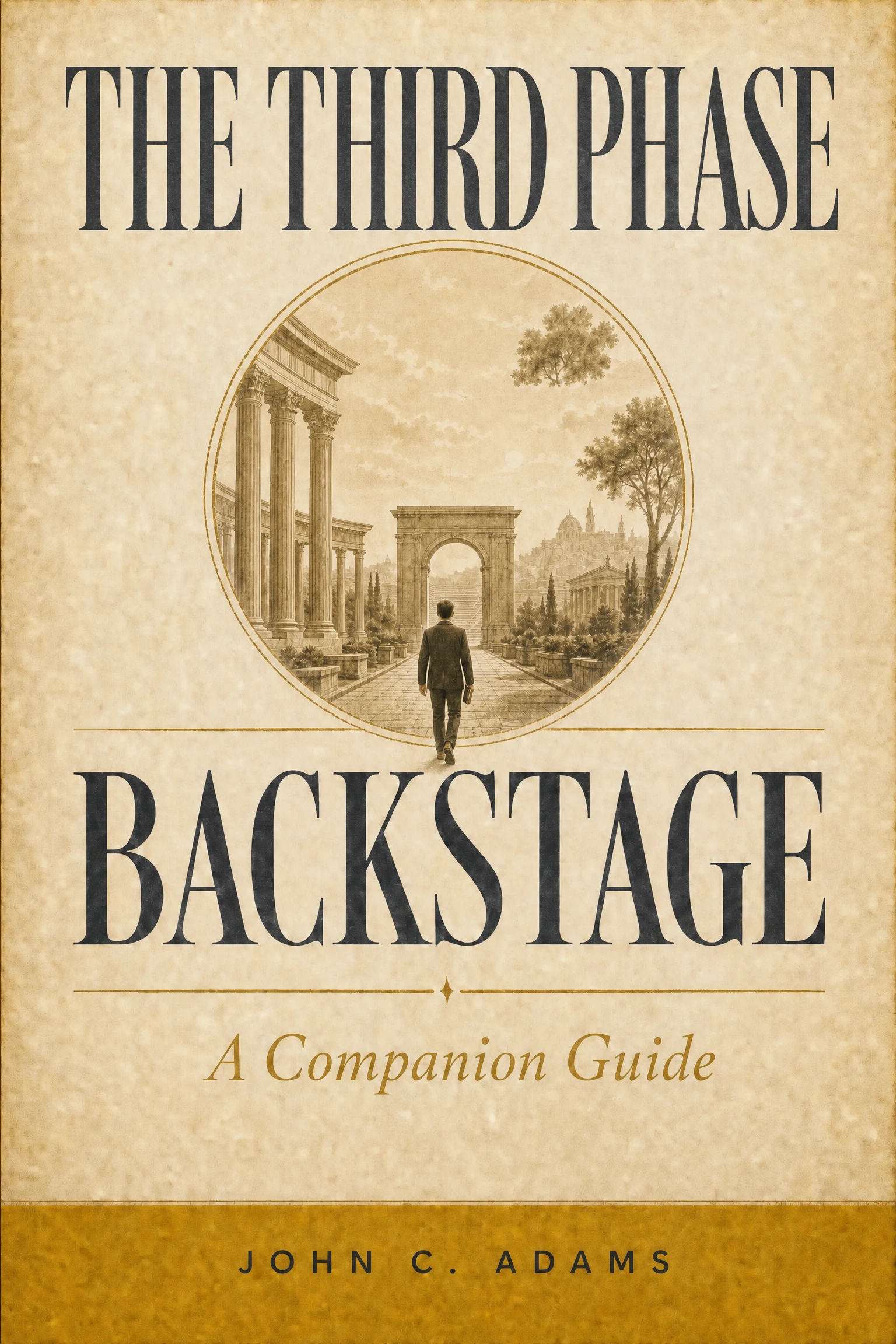
What is BACKSTAGE?
If you closed the book thinking 'wait… was that on purpose?' — it was.
There are, roughly, two kinds of readers, and both get full value here — just from different places. If you read for story (character, plot, the pleasure of watching Carlos's life unfold across seventy-five years), Part One is built for you: a clean, part-by-part refresher on everything that happened. If you're the kind of reader who finished the book and immediately wanted to know more, then Parts Two and Three are where that curiosity gets rewarded: who Rosey's real intellectual model actually is, why Augustine gets more space than Plato despite the cover, what a particular character's name is quietly doing.
Nothing in this Companion is required. Nothing here is the "correct" way to have read the novel. The Third Phase was written to work on its own, and it does. This is additive, not a prerequisite — a second layer for readers who want one, not a hidden answer key without which the first layer doesn't fully make sense.
How it's organized
Three parts. Read front to back, or skip straight to wherever your curiosity is loudest.
Part One
The Story
A three-paragraph summary of each of the novel's five parts (Fame and Fortune, Criminals and Saints, Wisdom and Justice, Neighborhoods and Asylums, Fear and Love), followed by fifteen fill-in-the-blank questions per section, aimed at exactly the details that resurface in Parts Two and Three. Answers appear on the very next page, so refreshing your memory never means flipping to the back of the book.
Part Two
Seven Disciplines
The heart of BACKSTAGE. Seven disciplines cover the real thinkers, texts, and traditions the novel draws on — Philosophy, Theology, Political Theory, Psychology, Literature, Religion, and Economics. Sometimes explicitly, sometimes so quietly you'd never notice without someone pointing at it. Every discipline closes with its own Games and Puzzles section.
Part Three
Two Deep-Dive Modules
Extended, dedicated treatment of the two figures who matter most to the novel's own architecture: Plato and Augustine. Includes the author-confirmed reveal of which of the two actually models the novel's true philosophical arc, whatever the cover might suggest.
Part Two
Seven Disciplines — the heart of BACKSTAGE
Each discipline traces the real thinkers, texts, and traditions the novel draws on — and closes with its own Games and Puzzles section.
Section 2
Philosophy
Plato and the Socratic method, the nature of self and mind, Stoic resilience, freedom and the death of God, virtue and moral psychology, cosmology and the limits of reason.
+ Games & Puzzles
Section 3
Theology
Scripture, Christology, the problem of evil from more than 20 angles, power and the Kingdom of God, Francesca's Prayer in seven readings, mystical ascent and contemplative theology.
+ Games & Puzzles
Section 4
Political Theory
From the Republic to Rome, Machiavelli and Hobbes, the American and Latin American founding, global governance, liberty and individualism, True Democracy contested.
+ Games & Puzzles
Section 5
Psychology
William James on belief and conversion, five rival explanations for the conversion at 63, political and collective psychology, individual character portraits.
+ Games & Puzzles
Section 6
Literature
Epic and mythic frameworks applied to Carlos's journey, the utopian and dystopian tradition, naming and structural devices, the novel of ideas.
+ Games & Puzzles
Section 7
Religion
Eastern wisdom traditions, Islamic and Jewish philosophy, the Hebrew Bible, the New Testament and comparative religion.
+ Games & Puzzles
Section 8
Economics
Rosey as Thomas Sowell, free-market theory from Smith to Friedman, institutions and regulatory capture, the novel's own economic argument for growth and prosperity.
+ Games & Puzzles
Part Three — Deep-Dive Module
Plato & The Republic
Extended treatment of the text that the novel's cover announces as its foundation — with a close reading of the Republic itself, its direct counterparts in The Third Phase, and the question of how faithfully Adams follows Plato versus where he departs from him.
Part Three — Deep-Dive Module
Augustine
The figure who gets more space in BACKSTAGE than Plato himself — and the author-confirmed reveal of why Augustine, not Plato, actually models the novel's true philosophical arc. The answer will reframe everything you thought you understood about the book.
What BACKSTAGE answers
The questions you didn't know you were supposed to be asking.
The novel stages the word "justice" in five radically different mouths before a single character ever mentions philosophy directly. Hector calls a retaliatory killing "dispensing justice." Rosey's aunt explains American law to a five-year-old as a kind of fairness. Azadi's mother laments that "our country isn't a just country." The word means something completely different every time — and the book is quietly asking you to notice that before it ever tells you it's asking.
BACKSTAGE is where you find out how deep that goes.
- Who is Rosey's real intellectual model?The answer is in the Economics section — and it reframes every scene she's in.
- Why does Augustine get more space than Plato?Despite what the cover suggests, one of these two figures actually models the novel's true arc. BACKSTAGE confirms which one — and why.
- What are the character names quietly doing?The Literature section on naming and structural devices reveals what you almost certainly missed on the first read.
- Five rival explanations for the conversion at 63.The Psychology section takes the novel's most contested moment and gives it the treatment it deserves.
- Francesca's Prayer — seven readings of one scene.The Theology section unpacks the most layered scene in the book from seven distinct interpretive angles.
Be the first to know
Get notified when BACKSTAGE publishes.
Join the list for launch updates and news about author events and appearances.
No spam. Unsubscribe at any time. Your information is never shared.